One Battle After Another
Front Row at the Movies by Shirrel Rhoades
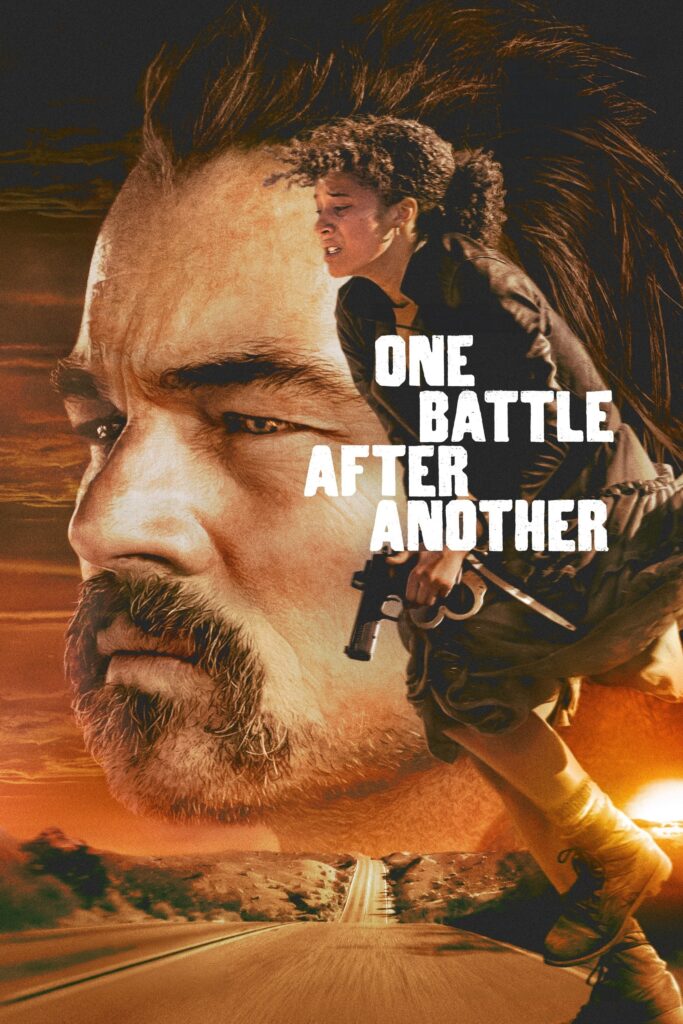
[mr_rating_result]“One Battle After Another” is an action thriller loosely based on Thomas Pynchon’s 1990 novel “Vineland.” The story examines “the free spirit of rebellion” of the ‘60s, the traits of the “fascistic Nixonian repression,” and the War on Drugs.
In this updated movie version, director Paul Thomas Anderson (“There Will Be Blood,” “Licorice Pizza”) gives us “a group of ex-revolutionaries reunite to rescue the daughter of one of their own.”
 Anderson’s films are often psychological dramas characterized by “depictions of desperate characters and explorations of dysfunctional families, alienation, loneliness, and redemption, alongside a bold visual style that uses constantly moving camera shots and long takes.”
Anderson started making films when he was eight years old, using a Betamax video camera. Encouraged by his father (a late-night TV horror host), he never had any other profession in mind.
A fan of Pynchon, Anderson had long wanted to adapt “Vineland” into a film. But fearing he was too close to the story, he set it aside and wrote a series of separate stories inspired by the novel. “One Battle After Another” combine those stories with elements of “Vineland” – particularly the father-daughter relationship in it.
The film stars Leonardo DiCaprio, Sean Penn, Benicio del Toro, Regina Hall, Teyana Taylor, and Chas Infiniti (in her film debut as the daughter).
Esquire Magazine says the film is “both a spy-craft yarn and a not-so-surprisingly prescient political thriller. At its core, it’s a story about a father and daughter. It’s also very funny.”
“One Battle After Another” marks Leonardo DiCaprio’s first film with writer-director Paul Thomas Anderson. DiCaprio plays Bob Ferguson, a washed-up revolutionary with a teenage daughter, Benicio Del Toro as the ally, and Sean Penn as the villain.
“This, to me, is a Paul Thomas Anderson version of an action film,” DiCaprio says. “I was like, car chases? How’s Paul going to do ‘French Connection’? What is he going to do that we haven’t seen Michael Bay do and make it a Paul thing?”
Anderson: “Why did it take us so long (to work together)?”
DiCaprio: “I know ‘One Battle After Another’ has been on your desk for a long time. It was a personal story for you in a lot of ways and certainly pertinent to the world that we’re living in right now. But ultimately, wanting to do this movie was pretty simple: I’ve been wanting to work with you for something like twenty years now, and I loved this idea of the washed-up revolutionary trying to erase his past and disappear and try and live some sort of normal life raising his daughter.”
Anderson: “It’s a nice character, someone who starts out wanting to change the world on the far left but gets increasingly cranky and closed off as he gets older.”
DiCaprio: “And lives in constant paranoia. It was fun creating a character that’s weirdly a hybrid of both political parties and beliefs—and certainly not Father of the Year.”
Why did it take Paul Thomas Anderson twenty years to do “One Battle After Another”?
He says, “Political films can be like eating your vegetables. There are many exceptions of great films that are political; however, right now the only thing I want to see is a story that I can relate to. And the only thing that matters is the emotional. The emotional comes from the story of a family. It comes from the way we love and hate. When films preach, I stop listening. It’s impossible to keep pace with the state of the world—this is why it’s best to focus on the things that never go out of style. You can figure out what never goes out of style by realizing what in a story is going to be the thing an audience really cares about. Our question is: Can a father find his daughter? Or: What does it mean to be a family?”
Email Shirrel: srhoades@aol.com


Become a Tropic Insider
Enter your email below to get the latest on showtimes and events.
Ratings & Comments
[mr_rating_form]